Top to bottom
Write upper strokes before lower strokes.

主 (zhǔ) — main / principal
Method
Learn why handwriting helps with Chinese vocabulary, stroke order, and long-term character recognition.
Handwriting slows you down just enough to see how a character is actually built.
Notice structure
You see components, proportions and spacing instead of a tangle of strokes.
Build character memory
Recalling every stroke in order ties shape, sound and meaning together.
Improve recognition
Characters you have written are the ones you read fastest later on.
Stroke order keeps characters balanced and legible, and helps you build reliable handwriting habits.
Write upper strokes before lower strokes.
主 (zhǔ) — main / principal
When a character has left and right parts, write the left side first.

吃 (chī) — to eat
Horizontal strokes usually come before vertical ones.

干 (gān) — dry / to do
When a character surrounds an inner part, write the outer structure first.

回 (huí) — to return
In box-like characters, the closing stroke is often written last.

日 (rì) — sun / day
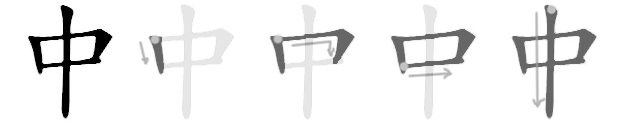
When there is a clear central stroke, it may come before the side strokes.
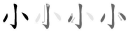
小 (xiǎo) — small
Stroke order helps keep the character visually balanced and centered.
中 (zhōng) — middle / center
Two simple grids give every character a frame to sit in.
Mi Zi Ge (米字格)
A cross and diagonals guide placement and proportions.
Tian Zi Ge (田字格)
A simple four-part square guides balance and spacing.
Start with larger squares, then move to smaller grids as your control improves.
Five short steps per word beat one long, irregular session.
Look
Read the character, pinyin, and meaning.
Understand
Notice the components or structure.
Trace
Follow the guided grey character.
Copy
Write the character next to the model.
Recall
Cover the model and write from memory.
For visual explanations of radicals, components, memory hooks, and character logic, visit Hanzi Made Simple.
Explore Hanzi Made Simple